
I published this essay on X on October 21, 2026: AI Is Saving Hours at the Desk and Creating Work in the Boardroom.
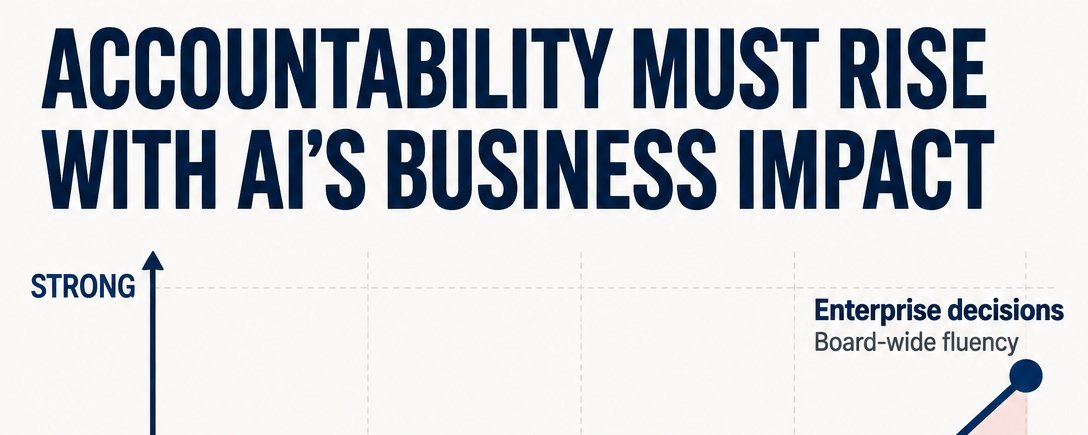
I spend most of my time running businesses, and that shapes how I look at AI. The technology is useful to me when it changes a real workflow: answering a lead faster, drafting a routine message, organizing information a team actually uses. Over the past two years, that kind of adoption has moved quickly. People are handing repetitive tasks to AI agents and getting real hours back.
At the same time, something else is happening at the top of these same companies. Boards are starting to treat AI as a material risk, and the disclosures prove it. The share of S&P 500 companies disclosing AI risk reached 72% in 2025, up from 12% in 2023.
These two trends look separate. They are the same trend, viewed from two altitudes.
The adoption happening at the task level is what creates the obligation at the oversight level. If your company is picking up time savings from AI, your leadership team is also picking up new responsibilities, whether anyone has named them yet or not.
The Task-Level Gains Are Real
Start with the good news, because it matters and it holds up.
AI handles specific, repetitive work well. Summarizing material. Drafting routine communication. Sorting records. Answering common customer questions. Adapting one piece of content for several platforms. Research on workflow automation shows AI for repetitive tasks can free up 20 to 40 percent of employee time, which lets people focus on higher-value work.
That matches what I see in practice. The wins come from narrow jobs with clear inputs and outputs. The failures come from vague assignments where nobody defined what good looks like.
The useful mental model is an assistant that executes repetitive work reliably. These tools replace manual processes that slow people down, and they free skilled workers to focus on decisions, judgment, and relationships with customers.
Human review still belongs in the loop. Accuracy matters. Sensitive decisions, customer commitments, financial numbers, and anything with legal exposure need a person who owns the output. That is a process design question, and it leads directly to the bigger issue.
Adoption Raises the Stakes for Governance
Here is the mechanism I want you to see clearly.
Every workflow you hand to AI increases the amount of your operation that runs on systems your leadership team must understand, supervise, and answer for. A company where AI drafts customer communication, scores leads, and summarizes financials has a different risk profile than the same company two years ago.
The disclosure data shows companies waking up to this. The total number of AI risks disclosed by S&P 500 companies jumped fivefold to 408 in 2025. Reputational risk tops the list, because a biased output, a privacy lapse, or a failed implementation erodes customer and investor trust fast.
Now compare that awareness to actual control. One analysis found that 97% of S&P 500 companies mention AI in their annual filing, while only about 3% document a governed process for managing AI risk: a named policy, standard, or committee tied to a specific control.
That distance between talking about AI and controlling AI is where the trouble lives.
In my experience running companies, risk you have named but have not assigned is risk you have chosen to carry. Somebody owns it by default, usually the CEO, usually without realizing how much of it has accumulated.
Why a Single AI Expert on the Board Falls Short
The instinct at many companies is to solve this with a hire. Recruit one director with AI credentials, point the AI questions at that seat, and move on.
I understand the appeal. The expertise shortage is real. Company filings show fewer than 3% of directors have AI expertise, and only 23% of executives rate their board as highly fluent in AI.
But the single-expert model misreads how AI enters a business. AI runs through hiring, pricing, customer service, credit decisions, and operations. There is no single agenda item for one expert to own. Every director will vote on matters AI has shaped, whether they realize it or not.
Oversight has to be distributed across the full board, the same way financial literacy is. You do not need every director to build models. You need every director able to ask useful questions:
- What business problem does this AI system address, and what is the baseline we measured before deploying it?
- Who owns the output when the system is wrong?
- Where does human review sit in the workflow, and who decided that?
- What happens to customer trust if this system fails publicly?
Directors seem to know this themselves. In one study, 71% of directors said their boards need stronger AI skills for effective oversight, the most frequently identified skills shortfall.
The Management Layer Decides Whether the Gains Compound
There is a third layer between the individual task and the board, and it gets the least attention: the daily management routines of the company.
This is where I think the earnings question actually gets decided.
If your team's administrative output doubles because of AI, and your meetings, performance reviews, and accountability structures stay exactly as they were, you have a measurement problem. You are evaluating people on activity that machines now handle, and you are missing the judgment work that now defines their value.
At my companies, we run on EOS, so the discipline is built into the rhythm: scorecards, clear owners, weekly review. When we put a tool into a workflow, it gets a measurable job. We define the problem, establish the baseline, and check whether the result improved. If it did, we document the new process and train to it. If it did not, we pull it.
That same discipline needs to reach the routines around the work:
- Meetings: If AI prepares the summary, spend the meeting on decisions, exceptions, and ownership.
- Performance reviews: Measure judgment, customer outcomes, and follow-through. Stop measuring volume the machine produces.
- Accountability: Name the human owner for every AI-touched workflow. "The system did it" is never an acceptable answer to a customer.
Companies that skip this redesign will see the time savings leak out through confusion, rework, and misaligned incentives. Companies that do the redesign turn reclaimed hours into margin.
A Practical Path for Leaders
You do not need a transformation program to start. You need a few clear moves with named owners.
First, inventory where AI already touches your operation. Include the unofficial uses. People are already using these tools whether you sanctioned them or not, and you cannot govern what you have not mapped.
Second, give every AI workflow a measurable job and a human owner. Problem, baseline, result. If you cannot state what the tool improved, you have a cost, and you should treat it like one.
Third, put human review where the consequences are. Customer commitments, money, safety, and legal exposure get a person who signs off. Routine drafting and sorting can run lighter.
Fourth, build board-wide AI fluency instead of outsourcing it to one seat. Education sessions, standing questions in every strategic review, and honest reporting that connects AI activity to business results and risks.
Fifth, update one management routine this quarter. Pick a meeting or a review process, redesign it around the work AI now handles, and measure whether decisions got faster or better.
The Standard Stays the Same
I am optimistic about this technology because I have watched it do useful work in real businesses, including mine. The hours it returns are real. The leverage is real.
The obligation that arrives with it is also real. Adoption at the bottom of the organization and accountability at the top grow together, and leaders who treat them as one system will capture more of the value with less of the risk.
The operating standard I apply to everything applies here without modification. Set a clear standard. Build the system to support it. Measure whether it works. Keep improving.
Start this week. Pick one AI workflow in your business, name its owner, and write down what it is supposed to improve. That single step puts you ahead of most of the disclosure statements being filed right now.
Where to go next
The original is on X: AI Is Saving Hours at the Desk and Creating Work in the Boardroom.
If you want this installed in the operation, start with Airus Advisory. Related reading: Enterprise AI Workflows and the Operating Leverage Equation and Why Standardized Operations Must Come Before AI in Roofing.